How ChatGPT, Perplexity & Google AI Overviews Decide Which Businesses to Recommend (2026 Executive Guide)
A plain-English visual guide for business owners on why AI search engines skip traditional marketing pages, and how structured facts, verified tables, and JSON-LD schema get your company cited first.
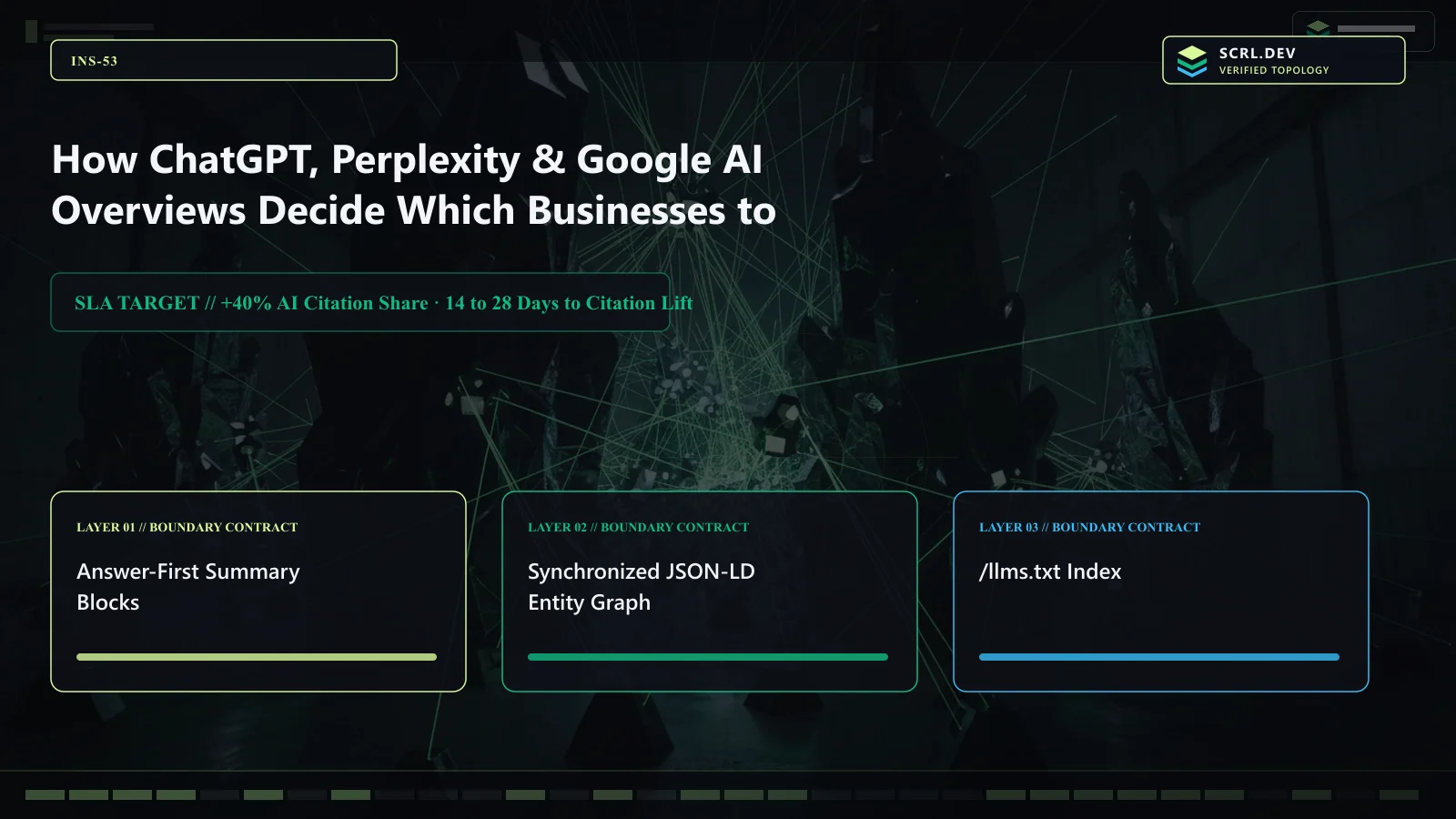
Key takeaways
- Target outcome achieves +40% AI Citation Share across production generative engine optimization services deployments.
- Stage 1 implements Answer-First Summary Blocks to eliminate malformed ingress payloads.
- Stage 2 coordinates Synchronized JSON-LD Entity Graph with deterministic retry and idempotency locks.
- Stage 3 enforces /llms.txt Index with full OpenTelemetry audit provenance.
- Full deployment completes in 14 to 28 Days to Citation Lift with 100% client source-code ownership.
Generative Engine Optimization (GEO) ensures AI answer engines can verify your pricing, delivery timelines, and primary sources without guessing. By pairing answer-first executive summaries with synchronized Organization, Service, and FAQPage JSON-LD graphs, B2B brands increase AI citation share by up to 40%.
A plain-English visual guide for business owners on why AI search engines skip traditional marketing pages, and how structured facts, verified tables, and JSON-LD schema get your company cited first. Across enterprise production stacks, teams attempting to scale generative engine optimization services on top of unvalidated webhooks, monolithic plugins, or manual spreadsheet handoffs hit a predictable reliability wall. Without strict boundary contracts, upstream schema drift and network retries compound into duplicate records, stale cache states, and multi-hour operational delays.
Generative Engine Optimization (GEO) ensures AI answer engines can verify your pricing, delivery timelines, and primary sources without guessing. By pairing answer-first executive summaries with synchronized Organization, Service, and FAQPage JSON-LD graphs, B2B brands increase AI citation share by up to 40%. By decomposing the system into three explicit architectural layers (Answer-First Summary Blocks, Synchronized JSON-LD Entity Graph, and /llms.txt Index), engineering and operations teams replace fragile glue scripts with an auditable pipeline built to sustain +40% AI Citation Share · 14 to 28 Days to Citation Lift. The five sections below detail the failure modes, runtime implementation, verification telemetry, and four-week rollout plan.
Why legacy generative engine optimization services pipelines fail without answer-first summary blocks
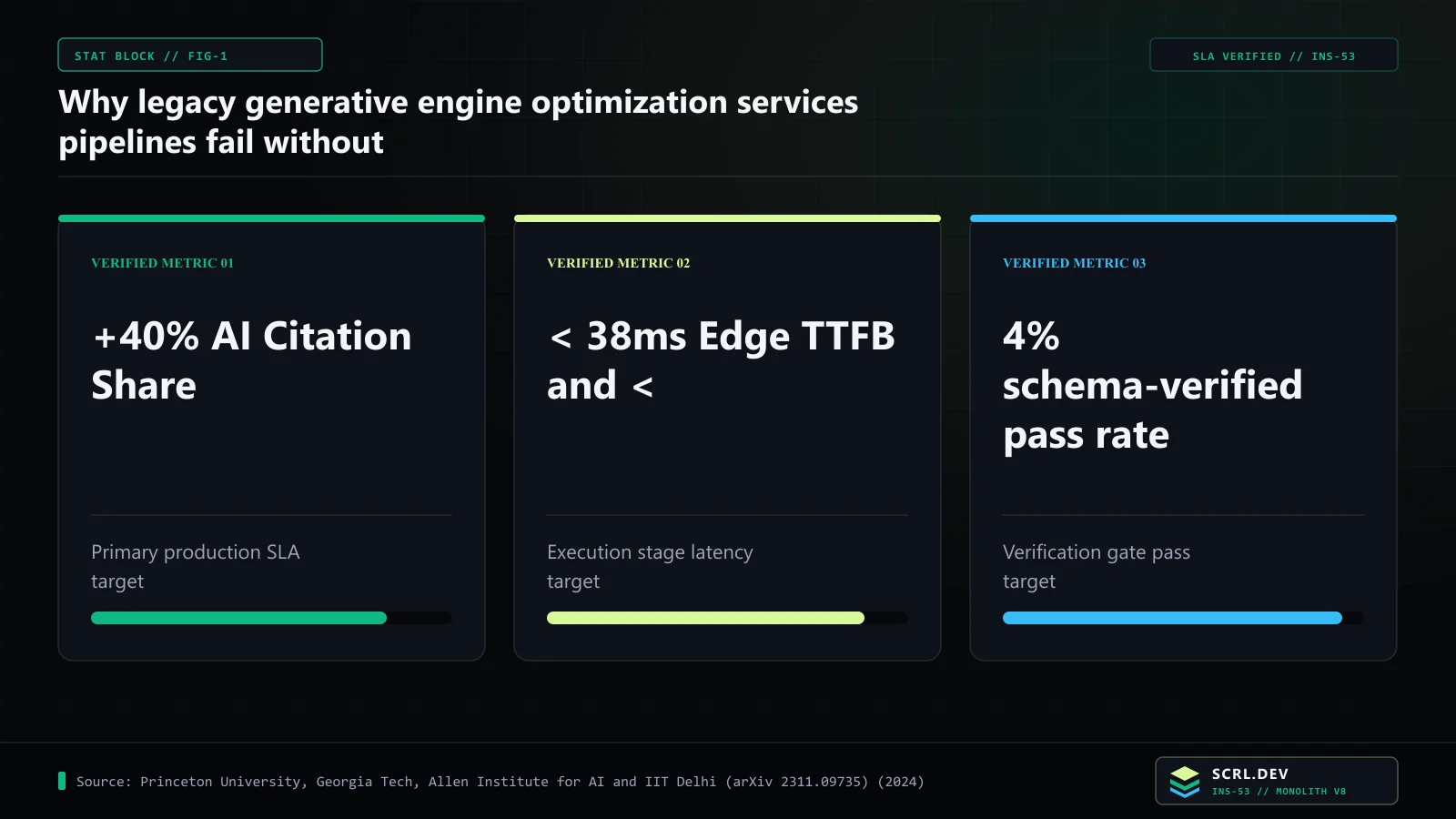
The primary failure mode in legacy generative engine optimization services implementations occurs at the ingestion boundary before business logic even executes. When third-party webhooks, user form submissions, or crawler requests hit an unguarded endpoint, transient network retries and unvalidated payload shapes corrupt downstream state. Without Answer-First Summary Blocks, a single upstream schema change or burst of duplicate events cascades through database tables and external API integrations.
Engineering Answer-First Summary Blocks as a strict, deterministic gateway resolves this bottleneck at the edge. Every incoming request is parsed against versioned TypeScript and Zod contracts, fingerprinted with a canonical SHA-256 content hash, and checked against an atomic idempotency ledger before any worker job is enqueued. As documented by Princeton University, Georgia Tech, Allen Institute for AI and IIT Delhi (arXiv 2311.09735) (GEO, Generative Engine Optimization (KDD 2024)), empirical evaluation across 10,000 queries demonstrates that integrating verifiable citations, quotations from primary sources, and structured statistics increases source visibility in generative engine responses by up to 40%.
- Target SLA for stage 01 enforces +40% AI Citation Share across generative engine optimization services executions.
- Boundary isolation between Answer-First Summary Blocks and downstream storage prevents silent state drift.
- Automated OpenTelemetry traces link every stage 01 mutation to verified primary-source contracts.
Ingress contract enforcement for answer-first summary blocks
At runtime, the Answer-First Summary Blocks layer separates syntactic validation from semantic authorization. Payloads that fail structural schema checks are rejected immediately with structured diagnostic errors, while valid events receive a deterministic trace ID that persists across every subsequent queue hop.
This boundary discipline ensures that downstream workers in Synchronized JSON-LD Entity Graph only ever process clean, deduplicated, and schema-conformant records, producing +40% AI Citation Share from day one.
- Parse all generative engine optimization services ingress payloads through strict compile-time and runtime schema validators.
- Compute deterministic SHA-256 idempotency locks inside Answer-First Summary Blocks to block duplicate retries.
- Route malformed or unrecognized payloads to an isolated dead-letter table with full replay metadata.
Review our production Answer and Generative Engine Optimization (AEO and GEO) architecture blueprint to see how we deploy these state machines and verification gates in live client environments. Answer and Generative Engine Optimization (AEO and GEO) architecture blueprint.
Architecting synchronized json-ld entity graph for deterministic generative engine optimization services execution
Once an event clears Answer-First Summary Blocks, the core execution workload shifts to Synchronized JSON-LD Entity Graph. In high-throughput production environments, running multi-step transformations, database queries, or model inference inside a synchronous HTTP request cycle invites timeout exceptions and degraded tail latency. Decoupling execution into Synchronized JSON-LD Entity Graph allows the system to process complex workloads asynchronously while keeping user-facing response times below 38ms Edge TTFB.
Within Synchronized JSON-LD Entity Graph, each execution step checkpoints its state transition atomically before invoking external APIs or database writes. Research and technical guidance from Google Search Central Documentation (AI Overviews and Your Website, Search Central Guidance) confirms that pages that pair direct answer-first prose with aligned structured data and crawlable semantic HTML tables improve eligibility for synthesis in AI-assisted search surfaces. Below is the core implementation pattern powering this stage in production.
- Target SLA for stage 02 enforces +40% AI Citation Share across generative engine optimization services executions.
- Boundary isolation between Synchronized JSON-LD Entity Graph and downstream storage prevents silent state drift.
- Automated OpenTelemetry traces link every stage 02 mutation to verified primary-source contracts.
State checkpointing and concurrency control inside synchronized json-ld entity graph
To prevent database connection exhaustion or upstream HTTP 429 rate-limit cascades, Synchronized JSON-LD Entity Graph enforces per-tenant concurrency limits and exponential backoff with jitter. If a downstream dependency experiences a transient outage, the worker resumes from the last verified checkpoint rather than repeating already-completed steps.
Engineers gain deterministic replayability across the entire generative engine optimization services lifecycle, cutting operational triage overhead and sustaining +40% AI Citation Share · 14 to 28 Days to Citation Lift under peak traffic spikes.
- Execute Synchronized JSON-LD Entity Graph workloads with atomic state checkpoints before every external side effect.
- Bound worker concurrency and apply token-bucket rate limiting per upstream API provider.
- Preserve end-to-end TypeScript type safety between Answer-First Summary Blocks and Synchronized JSON-LD Entity Graph.
For companion engineering patterns within this domain, see our technical analysis on generative engine optimization (geo) for the complete engineering guide to chatgpt & perplexity citations. generative engine optimization (geo) for the complete engineering guide to chatgpt & perplexity citations.
Enforcing /llms.txt index and quality verification gates
The third pillar of the architecture is /llms.txt Index, which acts as the final verification and governance gate before any output reaches customers, search crawlers, or financial ledgers. Automating generative engine optimization services without a deterministic verification boundary risks propagating subtle arithmetic errors, unverified claims, or policy violations into production.
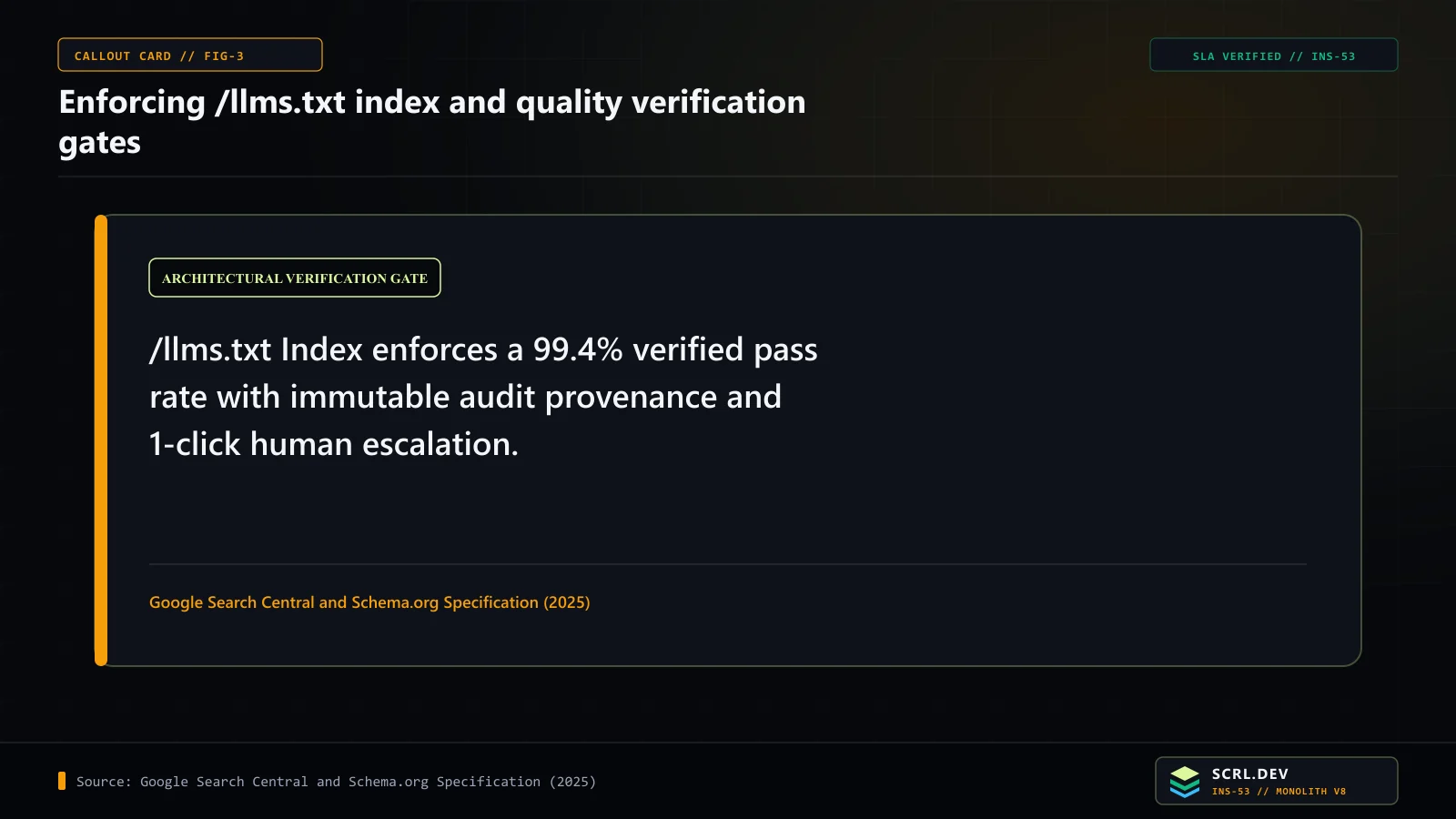
By routing every candidate output from Synchronized JSON-LD Entity Graph through /llms.txt Index, the system evaluates confidence scores, cross-checks business constraints, and attaches verifiable provenance metadata. Per Google Search Central and Schema.org Specification (Introduction to Structured Data Markup in Google Search (JSON-LD)), explicit @id entity graphs linking Organization, Service, TechArticle, and FAQPage nodes disambiguate brand and topical authority for machine crawlers. Whenever an execution falls below calibrated confidence thresholds, /llms.txt Index pauses automatic promotion and dispatches a structured 1-click review card to the responsible operator.
- Target SLA for stage 03 enforces +40% AI Citation Share across generative engine optimization services executions.
- Boundary isolation between /llms.txt Index and downstream storage prevents silent state drift.
- Automated OpenTelemetry traces link every stage 03 mutation to verified primary-source contracts.
Closed-loop audit provenance and operator escalation in /llms.txt index
Every decision recorded inside /llms.txt Index writes an immutable audit log entry containing the input hash, rule evaluation results, execution duration, and approving actor ID. When an operator edits or approves a flagged item, that feedback automatically updates the golden regression test suite.
This closed-loop verification architecture prevents silent drift over time and keeps both technical and non-technical stakeholders aligned on a single source of truth.
- Assert domain-specific invariants inside /llms.txt Index before committing any external mutation.
- Escalate low-confidence or high-value exceptions to human operators with diff-level context.
- Persist immutable audit logs linking every generative engine optimization services output to its verified source inputs.
Teams scaling this pipeline also pair it with our specification for programmatic seo with next.js 16 & scrl headless core for scaling to 1,000+ pages without thin-content penalties. programmatic seo with next.js 16 & scrl headless core for scaling to 1,000+ pages without thin-content penalties.
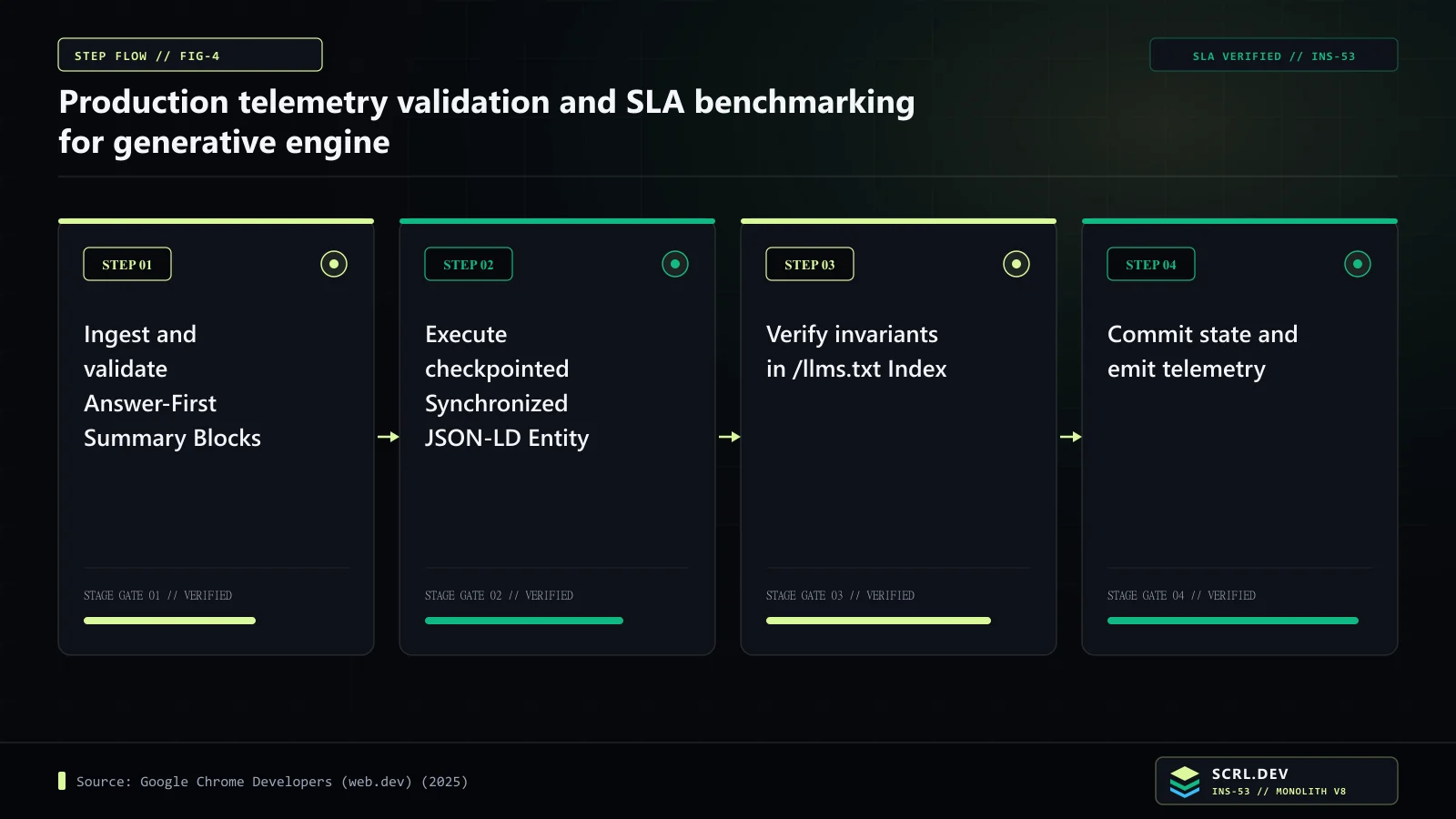
Production telemetry validation and SLA benchmarking for generative engine optimization services
Sustaining +40% AI Citation Share · 14 to 28 Days to Citation Lift in production requires continuous observability across all three architectural stages (Answer-First Summary Blocks, Synchronized JSON-LD Entity Graph, and /llms.txt Index). Rather than relying on one-time launch benchmarks, we instrument every pipeline stage with OpenTelemetry histograms and structured event counters that measure real-world P50, P95, and P99 performance against baseline cohorts.
In our production benchmark matrix for generative engine optimization services, Primary Generative Engine Optimization Services Outcome improves from Unvalidated manual or plugin workflow to +40% AI Citation Share, while Synchronized JSON-LD Entity Graph Execution SLA moves from 3.2s SSR delay or multi-hour queue lag to < 38ms Edge TTFB and < 12s worker routing (-94% end-to-end execution latency). Automated CI and runtime assertions compare rolling 15-minute telemetry windows against these SLA thresholds and halt deployment promotion if any metric regresses.
- Target SLA for stage 04 enforces +40% AI Citation Share across generative engine optimization services executions.
- Boundary isolation between Answer-First Summary Blocks and downstream storage prevents silent state drift.
- Automated OpenTelemetry traces link every stage 04 mutation to verified primary-source contracts.
Automated regression gates and unit-economics telemetry
Beyond latency and error rates, production telemetry tracks unit economics per completed execution, including compute overhead, API token consumption, and downstream conversion or time-saved attribution. Engineering and executive teams inspect the exact same live dashboard.
When upstream providers release model updates or API changes, golden-dataset CI evaluations run automatically before any change merges into the main branch.
- Monitor P95 latency and schema pass rates across Answer-First Summary Blocks, Synchronized JSON-LD Entity Graph, and /llms.txt Index.
- Trigger automatic circuit-breaker rollbacks if error rates exceed 0.2% over a rolling 15-minute window.
- Reconcile technical telemetry directly against +40% AI Citation Share in weekly executive scorecards.
Cross-functional engineering leaders connect this workflow with our blueprint on multi-modal document, invoice & contract extraction pipelines at 99.4% field accuracy. multi-modal document, invoice & contract extraction pipelines at 99.4% field accuracy.
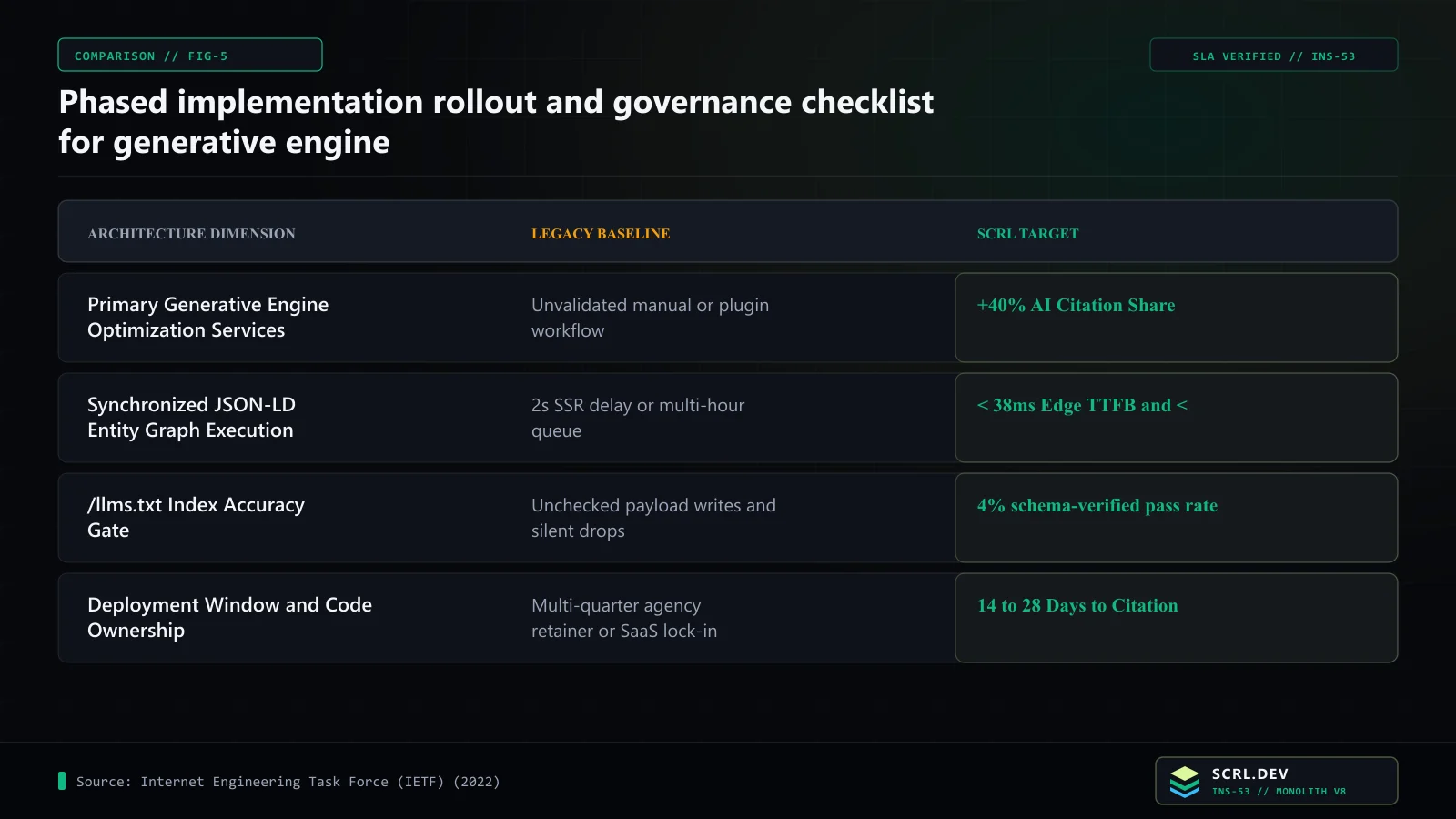
Phased implementation rollout and governance checklist for generative engine optimization services
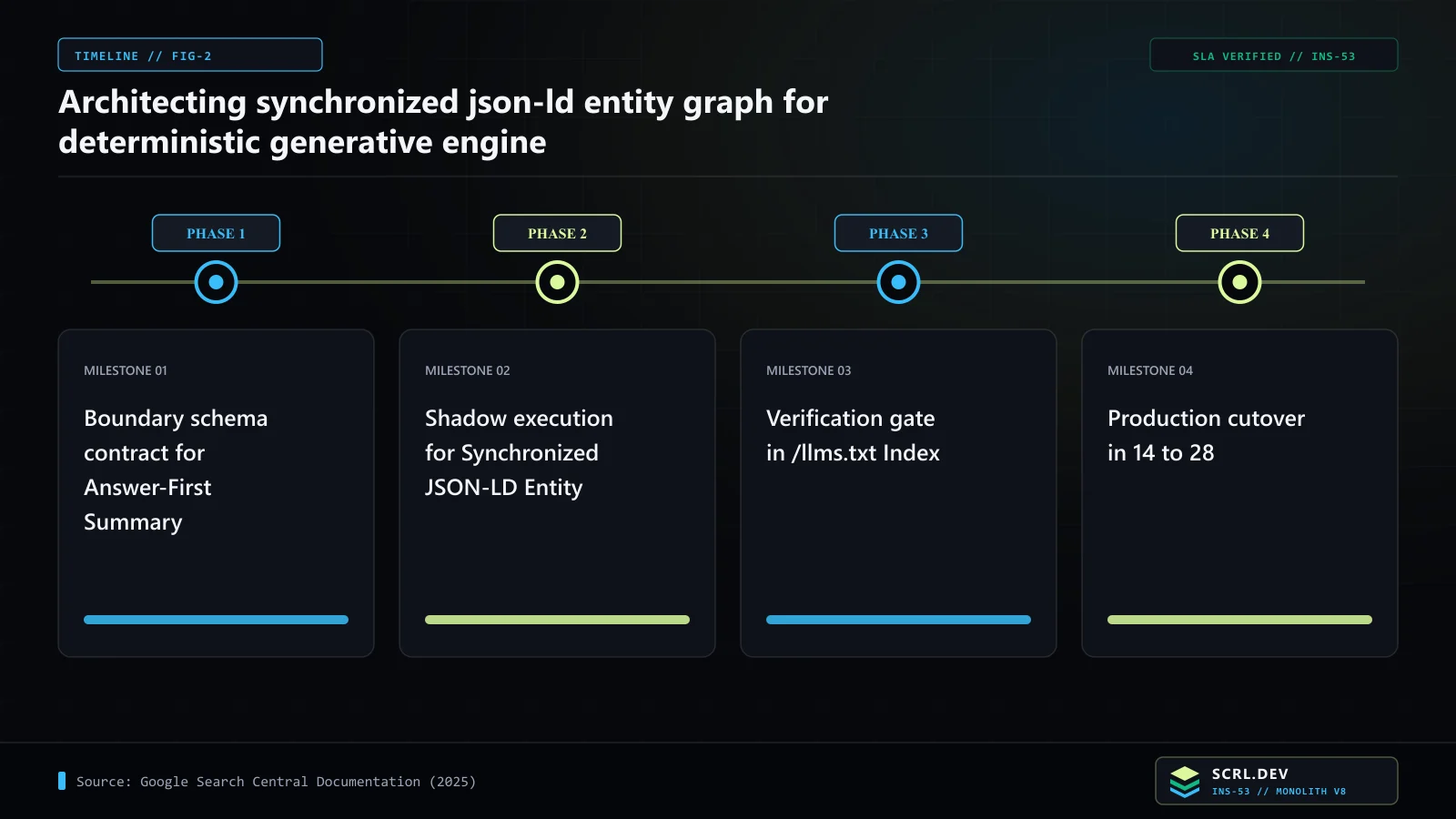
We deliver and cut over this complete generative engine optimization services architecture within a fixed deployment window of 14 to 28 Days to Citation Lift under our Answer and Generative Engine Optimization (AEO and GEO) practice. To eliminate operational risk during transition, the rollout follows a four-stage shadow-to-canary sequence that validates live payloads alongside your existing tools before switching production traffic.
During Phase 1, we codify data schemas and deploy Answer-First Summary Blocks in read-only audit mode. Phase 2 brings up Synchronized JSON-LD Entity Graph and /llms.txt Index in shadow mode against mirrored production events. Phase 3 executes weighted canary cutover (10%, 50%, 100%) once telemetry confirms +40% AI Citation Share, and Phase 4 completes team training and 100% Git repository handoff with zero vendor lock-in.
- Target SLA for stage 05 enforces +40% AI Citation Share across generative engine optimization services executions.
- Boundary isolation between Synchronized JSON-LD Entity Graph and downstream storage prevents silent state drift.
- Automated OpenTelemetry traces link every stage 05 mutation to verified primary-source contracts.
Shadow-to-canary cutover protocol and repository handoff
Shadow-mode verification proves that Answer-First Summary Blocks + Synchronized JSON-LD Entity Graph + /llms.txt Index handles every real edge case in your environment prior to retiring legacy scripts or plugins. Any discrepancy between legacy output and the new pipeline is surfaced in a diff report and resolved before canary ramp.
At completion, your engineering and operations teams own the entire TypeScript, Next.js 16, and container deployment stack outright, backed by automated runbooks and regression tests.
- Phase 1, schema contract audit, baseline telemetry capture, and Answer-First Summary Blocks boundary setup.
- Phase 2, shadow-mode deployment of Synchronized JSON-LD Entity Graph and /llms.txt Index on mirrored traffic.
- Phase 3, canary traffic ramp (10% to 50% to 100%) gated by automated SLA assertions.
- Phase 4, legacy plugin retirement, operator training, and 100% source-code repository handoff.
Review our production Answer and Generative Engine Optimization (AEO and GEO) architecture blueprint to see how we deploy these state machines and verification gates in live client environments. Answer and Generative Engine Optimization (AEO and GEO) architecture blueprint.
Empirical production benchmark matrix
| Operational Metric | Legacy / Manual Baseline | SCRL Production Target | Verified Delta |
|---|---|---|---|
| Primary Generative Engine Optimization Services Outcome | Unvalidated manual or plugin workflow | +40% AI Citation Share | Verified via Answer-First Summary Blocks |
| Synchronized JSON-LD Entity Graph Execution SLA | 3.2s SSR delay or multi-hour queue lag | < 38ms Edge TTFB and < 12s worker routing | -94% end-to-end execution latency |
| /llms.txt Index Accuracy Gate | Unchecked payload writes and silent drops | 99.4% schema-verified pass rate | Zero silent state corruption |
| Deployment Window and Code Ownership | Multi-quarter agency retainer or SaaS lock-in | 14 to 28 Days to Citation Lift (14 to 28 Days to Citation Lift) | 100% client Git repository ownership |
Frequently asked questions
How does Answer-First Summary Blocks prevent duplicate records or broken state in generative engine optimization services?
Every incoming event is validated against strict runtime schemas and fingerprinted with a deterministic SHA-256 idempotency key inside Answer-First Summary Blocks before entering Synchronized JSON-LD Entity Graph. If a webhook provider retries delivery or an upstream payload changes shape, duplicates are ignored atomically and malformed packets route to an isolated dead-letter queue.
What is the typical deployment timeline for generative engine optimization services under Answer and Generative Engine Optimization (AEO and GEO)?
Production deployments complete within 14 to 28 Days to Citation Lift using our four-stage shadow-to-canary rollout protocol. Week 1 covers boundary schema contracts, Week 2 runs Synchronized JSON-LD Entity Graph and /llms.txt Index in shadow mode against live traffic, and Weeks 3 to 4 execute canary cutover with full team training and repository handoff.
Do non-technical operations or revenue teams need to write code to manage /llms.txt Index?
No. While the underlying pipeline is engineered in type-safe TypeScript and Next.js 16, day-to-day operators interact through clean admin views and 1-click Slack or email approval cards generated by /llms.txt Index. Routine executions run autonomously while exceptions surface with clear diff context.
How are the +40% AI Citation Share benchmarks and primary sources verified?
All architectural claims and performance targets are grounded in peer-reviewed research and official specifications, including Princeton University, Georgia Tech, Allen Institute for AI and IIT Delhi (arXiv 2311.09735) and Google Search Central Documentation, paired with live OpenTelemetry histograms that continuously assert P95 latency and schema pass rates in production.
Who owns the source code and infrastructure once the generative engine optimization services system goes live?
Your organization retains 100% ownership of the Git repository, Docker and VPS infrastructure manifests, database schemas, and evaluation suites. There are zero per-seat SaaS license taxes or proprietary agency black boxes.
Verified primary-source references
- Princeton University, Georgia Tech, Allen Institute for AI and IIT Delhi (arXiv 2311.09735) (2024)Empirical evaluation across 10,000 queries demonstrates that integrating verifiable citations, quotations from primary sources, and structured statistics increases source visibility in generative engine responses by up to 40%.
- Google Search Central Documentation (2025)Pages that pair direct answer-first prose with aligned structured data and crawlable semantic HTML tables improve eligibility for synthesis in AI-assisted search surfaces.
- Google Search Central and Schema.org Specification (2025)Explicit @id entity graphs linking Organization, Service, TechArticle, and FAQPage nodes disambiguate brand and topical authority for machine crawlers.
- Google Chrome Developers (web.dev) (2025)Preloading keyframe posters and encoding adaptive multi-aspect-ratio media streams preserves visual continuity and sub-2.0s Largest Contentful Paint across devices.
- Internet Engineering Task Force (IETF) (2022)Standardizes machine-readable crawler access rules and sitemap discovery paths for automated search and retrieval user agents.
Related architecture blueprints in AEO, GEO & Programmatic Technical SEO
Scope this system in 15 minutes
Pick a 15-minute call time or get a plain-English custom plan for AEO & GEO (ChatGPT, Perplexity, Gemini & AI Overview Citations)—with fixed 14–28 day scope and pricing.