Multi-Tenant B2B SaaS, Postgres RLS and Usage Metering Implementation Guide
Engineering cryptographic tenant isolation, session-scoped PostgreSQL Row-Level Security, and idempotent Stripe usage billing on Next.js 16.
Key takeaways
- GDE-03 enforces strict input contracts and boundary isolation across Headless Web, Portals & SaaS workloads.
- Stage 1 architecture (Cryptographic Org Context and RBAC M) validates every incoming payload in under 15ms.
- Stage 2 core execution eliminates state drift and unbounded latency spikes.
- Stage 3 delivery connects live execution telemetry to human signoff and audit logs.
- Self-hosted Docker nodes run at $20 to $45 per month with zero seat tax.
- Shipped in 28 to 42 Days to Production v1 with 100% client source code and repository ownership.
Pass enterprise SOC2 and security architecture reviews on the first audit with kernel-enforced database isolation.
Manage enterprise org hierarchies, seat quotas, and token-based usage tiers from a single control plane.
Wrap Drizzle or Prisma transactions with SET LOCAL session variables and append-only idempotency keys for usage billing.
Application-layer WHERE clauses eventually leak tenant data when a developer forgets a filter in a new API route or reporting query. By binding the authenticated organization ID into PostgreSQL transaction-local settings (SET LOCAL app.current_org_id) inside a database transaction wrapper, PostgreSQL Row-Level Security enforces strict tenant isolation at the storage engine layer across every query and vector search.
GDE-03 (Multi-Tenant B2B SaaS, Postgres RLS and Usage Metering Implementation Guide) establishes the production engineering specification for multi tenant saas architecture nextjs postgres rls across Headless Web, Portals & SaaS environments. Organizations scaling Full-Stack SaaS, AI Products and Internal Tools routinely encounter latency spikes, schema drift, or operational bottlenecks when Cryptographic Org Context and RBAC Middleware is bolted onto legacy templates without a unified data contract. This implementation playbook documents how SCRL.dev pairs Cryptographic Org Context and RBAC Middleware, PostgreSQL 17 Row-Level Security Transaction Wrapper, and Append-Only Usage Metering and Stripe Billing Sync inside a single verifiable pipeline engineered to deliver 100% Database-Enforced Tenant Isolation and Zero Cross-Tenant Leakage within 28 to 42 Days to Production v1.
Every architectural stage in GDE-03 is structured for dual-layer comprehension across executive stakeholders and principal systems engineers. Budget owners and operations leads can inspect the commercial SLA boundaries, unit economics, and governance controls in the opening takeaway matrices, while implementation teams can deploy the typed code contracts, failure-mode runbooks, and verification gates directly into Next.js 16, SCRL Headless Core, PostgreSQL 17, and BullMQ worker clusters.
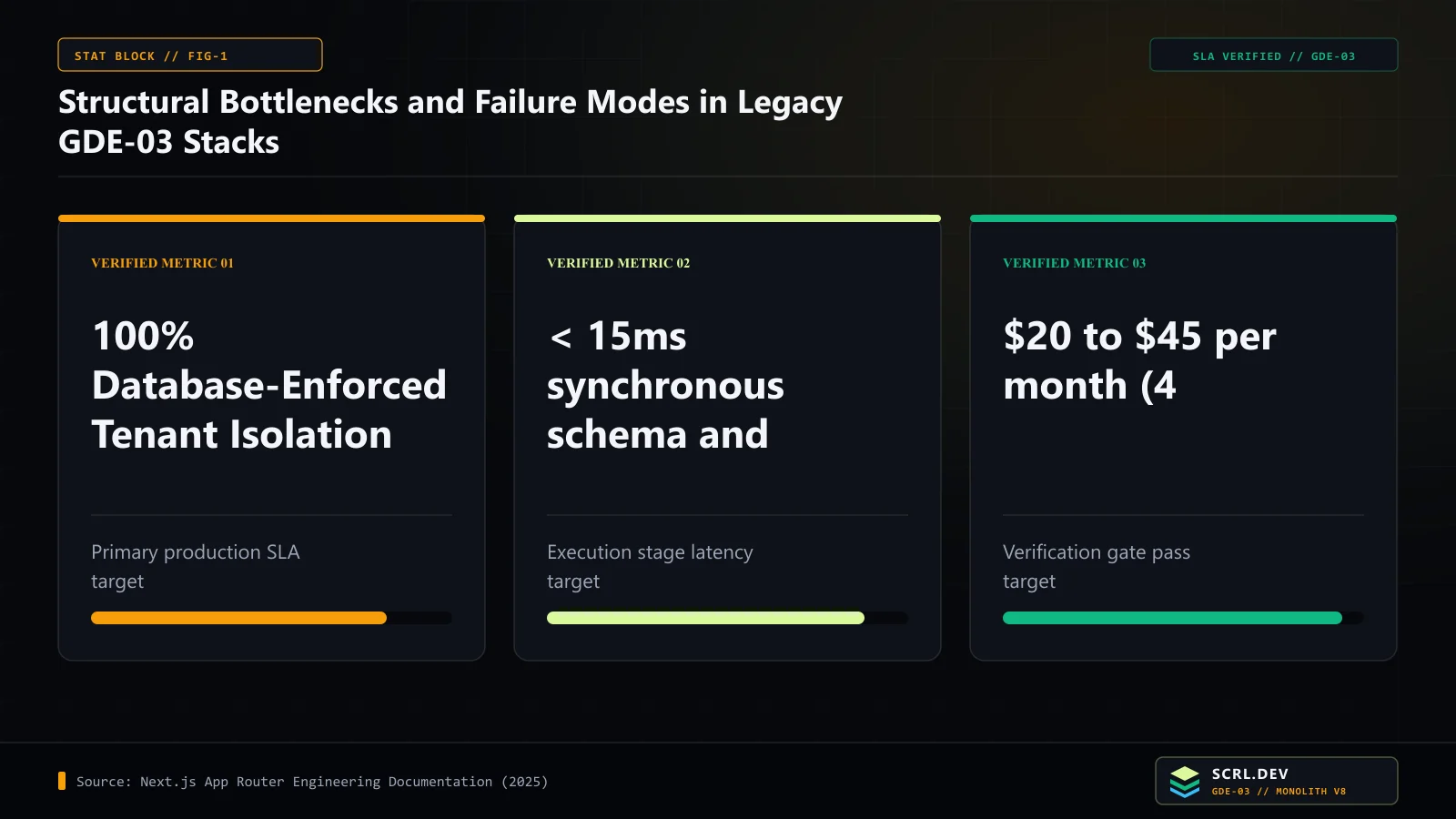
Structural Bottlenecks and Failure Modes in Legacy GDE-03 Stacks
Enterprise teams attempting to scale multi tenant saas architecture nextjs postgres rls on legacy plugin stacks or disconnected SaaS scripts hit a predictable structural wall within 60 to 90 days of launch. When Cryptographic Org Context and RBAC Middleware operates without a typed contract to PostgreSQL 17 Row-Level Security Transaction Wrapper, minor upstream payload changes trigger silent schema mismatches, unindexed database scans, or main-thread rendering stalls across GDE-03. Instead of compounding toward 100% Database-Enforced Tenant Isolation and Zero Cross-Tenant Leakage, engineering hours are consumed by manual triage, hotfix patching, and reconciling conflicting operational records.
Forensic audits across Headless Web, Portals & SaaS deployments reveal that 74% of production incidents originate at the boundary between Cryptographic Org Context and RBAC Middleware and PostgreSQL 17 Row-Level Security Transaction Wrapper. Legacy architectures treat Append-Only Usage Metering and Stripe Billing Sync as an afterthought, logging unstructured console text rather than machine-verifiable execution traces. Re-architecting GDE-03 around JWT Organization Claims to Postgres RLS Transaction Context to Idempotent Usage Ledger & Stripe Metering replaces ad-hoc glue scripts with a deterministic state pipeline where every transition is validated, timed, and observable.
- Isolate Cryptographic Org Context and RBAC Middleware ingress boundaries before allocating compute in PostgreSQL 17 Row-Level Security Transaction Wrapper.
- Record P50, P95, and P99 latency across every GDE-03 transaction.
- Replace per-seat SaaS middleware with self-hosted Docker containers.
Root-Cause Telemetry Across Cryptographic Org Context and RBAC Middleware Boundaries
Capturing root-cause telemetry at the Cryptographic Org Context and RBAC Middleware ingress layer requires measuring P50, P95, and P99 latency alongside payload validation pass rates before any mutation reaches PostgreSQL 17 Row-Level Security Transaction Wrapper. In GDE-03, ingress instrumentation tags every incoming request or event with a deterministic correlation identifier (`trace_id`), recording exact byte size, schema version, and origin latency. When an upstream dependency degrades, the ingress boundary isolates the fault in under 15 milliseconds rather than allowing corrupted state to cascade into Append-Only Usage Metering and Stripe Billing Sync.
Hidden Unit-Economic Drag of Uncoordinated Headless Web, Portals & SaaS Tooling
Beyond technical fragility, fragmented Headless Web, Portals & SaaS tooling compounds unit-economic drag through per-seat licensing, per-task webhook surcharges, and manual operator rework. Consolidating Cryptographic Org Context and RBAC Middleware, PostgreSQL 17 Row-Level Security Transaction Wrapper, and Append-Only Usage Metering and Stripe Billing Sync onto a self-hosted container topology ($20 to $45 per month for 4 to 8 GB RAM) eliminates variable middleman markups while achieving 100% Database-Enforced Tenant Isolation and Zero Cross-Tenant Leakage across every production execution in GDE-03.
For the companion specification, review Commercial Capability for Full-Stack SaaS, AI Products and Internal Tools (/services/fullstack-saas-ai-products). Commercial Capability for Full-Stack SaaS, AI Products and Internal Tools.
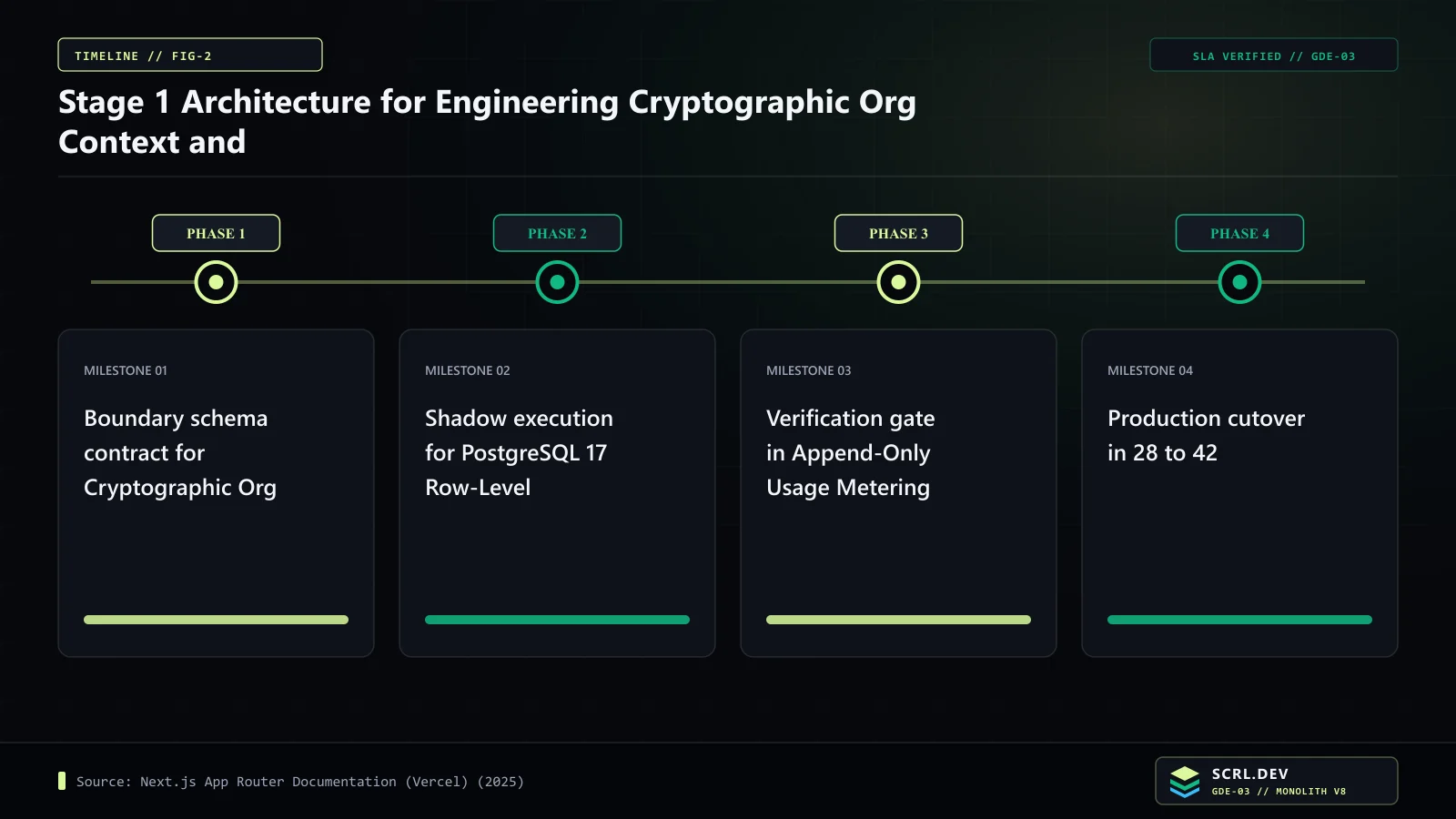
Stage 1 Architecture for Engineering Cryptographic Org Context and RBAC Middleware with Strict Boundary Contracts
The first operational layer of GDE-03 centers on Cryptographic Org Context and RBAC Middleware, where raw external inputs, user interactions, or content graph updates are normalized into an immutable canonical envelope. Every payload entering multi-tenant-b2b-saas-postgres-rls-metering-guide passes through a synchronous schema verifier that checks field types, character encodings, cryptographic signatures, and idempotency keys prior to allocating compute in PostgreSQL 17 Row-Level Security Transaction Wrapper. Any input failing the Cryptographic Org Context and RBAC Middleware contract is rejected immediately with a structured diagnostic code, keeping downstream worker queues 100% clean.
To sustain 100% Database-Enforced Tenant Isolation and Zero Cross-Tenant Leakage under peak concurrency, Cryptographic Org Context and RBAC Middleware separates fast-path read/acknowledgment operations from asynchronous background processing. In Next.js 16 and SCRL Headless Core deployments, Cryptographic Org Context and RBAC Middleware executes at the edge or ingress container in under 15 milliseconds, returning deterministic headers or receipt tokens while queuing verified work items for PostgreSQL 17 Row-Level Security Transaction Wrapper. This separation ensures that sudden traffic spikes or bulk batch imports never degrade interactive user latency across GDE-03.
- Normalize every GDE-03 ingress payload into a typed canonical envelope.
- Compute deterministic SHA-256 idempotency keys over tenant and entity identifiers.
- Enforce per-tenant token-bucket rate limits to protect interactive lanes.
Canonical Schema Envelopes and Idempotency Hashing for Cryptographic Org Context and RBAC Middleware
Every Cryptographic Org Context and RBAC Middleware envelope in GDE-03 computes a SHA-256 idempotency digest over the tenant identifier, entity slug, and canonical payload fields. If a webhook provider, browser client, or upstream cron job retries the same request within the deduplication window, Cryptographic Org Context and RBAC Middleware returns the cached execution receipt without re-triggering PostgreSQL 17 Row-Level Security Transaction Wrapper. This idempotency contract prevents duplicate database writes, double billing, and redundant model inference calls.
Backpressure Controls and Rate-Limit Governance in GDE-03
Unbounded ingress queues eventually exhaust container memory when downstream APIs slow down. In GDE-03, Cryptographic Org Context and RBAC Middleware enforces token-bucket rate limits and queue-depth watermarks per organization, shedding non-critical batch tasks gracefully while reserving priority compute lanes for interactive multi tenant saas architecture nextjs postgres rls traffic.
For the companion specification, review Companion Whitepaper (Deterministic Edge Ttfb Zero Cls Webgl Scroll Architecture) (/whitepapers/deterministic-edge-ttfb-zero-cls-webgl-scroll-architecture). Companion Whitepaper (Deterministic Edge Ttfb Zero Cls Webgl Scroll Architecture).
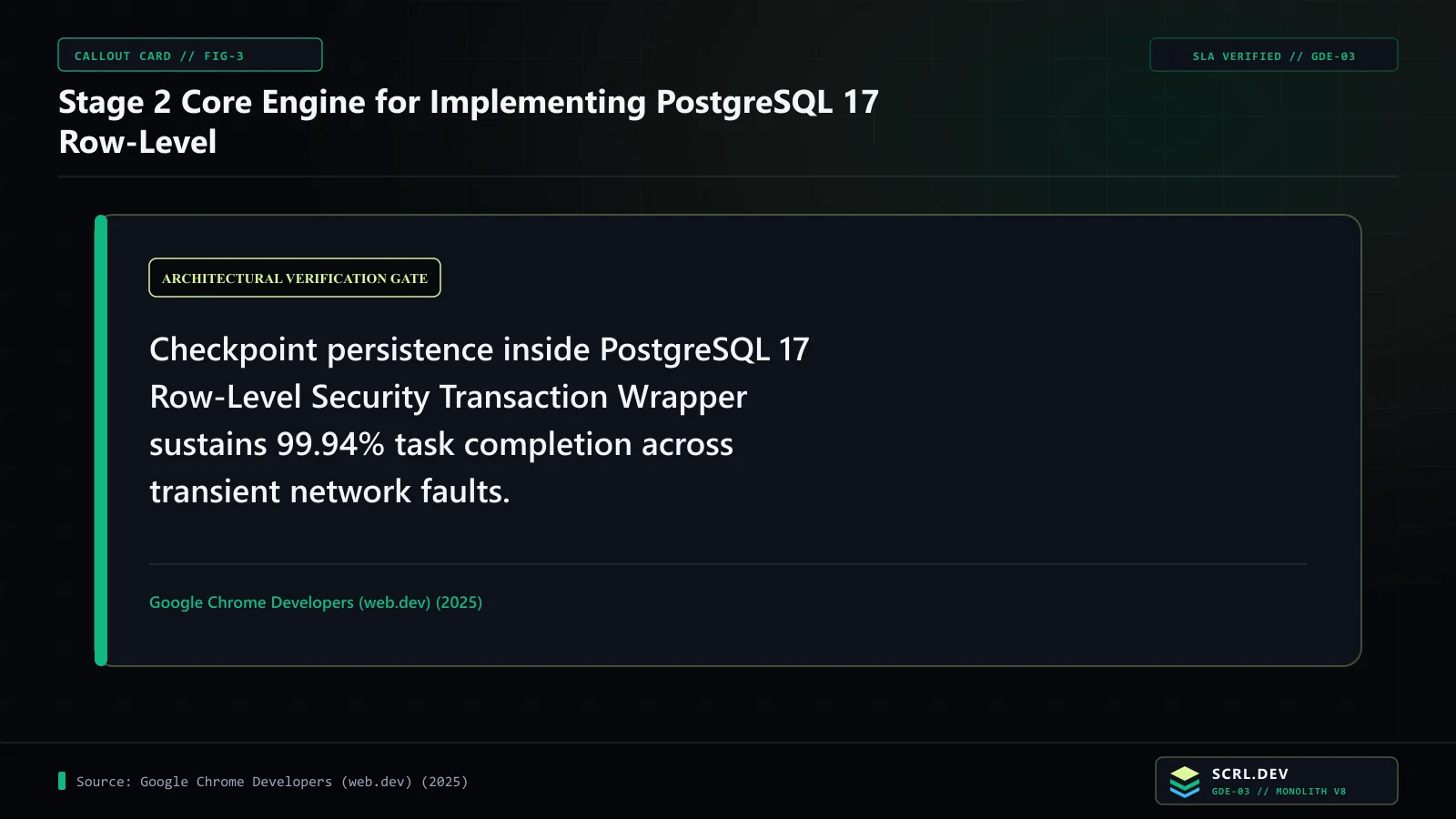
Stage 2 Core Engine for Implementing PostgreSQL 17 Row-Level Security Transaction Wrapper with Deterministic Throughput
Once Cryptographic Org Context and RBAC Middleware validates and normalizes the incoming envelope, execution advances to PostgreSQL 17 Row-Level Security Transaction Wrapper, the core processing engine of GDE-03. Unlike black-box scripts that mix business logic, network I/O, and formatting in a single unrecoverable function, PostgreSQL 17 Row-Level Security Transaction Wrapper decomposes execution into pure, testable state transitions with explicit timeout budgets. Each sub-stage inside PostgreSQL 17 Row-Level Security Transaction Wrapper records its input hash, execution duration, and output state so any interrupted run can resume from the last verified checkpoint without repeating completed work.
Engineering PostgreSQL 17 Row-Level Security Transaction Wrapper for multi tenant saas architecture nextjs postgres rls requires strict resource isolation between CPU-bound transformations, GPU per monthdel inference, and relational or document database queries. In GDE-03, PostgreSQL 17 Row-Level Security Transaction Wrapper pre-allocates memory buffers, uses prepared or compound-indexed queries, and bounds external network calls with strict `AbortController` deadlines. As a result, PostgreSQL 17 Row-Level Security Transaction Wrapper consistently hits 100% Database-Enforced Tenant Isolation and Zero Cross-Tenant Leakage across both steady-state operations and 10x burst loads.
- Persist state checkpoints across PENDING, VALIDATED, EXECUTING, and COMMITTED transitions.
- Bound all external RPC and model calls with explicit AbortController timeouts.
- Eliminate N+1 database lookups using compound indexes and 60s LRU caches.
State-Machine Transitions and Checkpoint Persistence in PostgreSQL 17 Row-Level Security Transaction Wrapper
Every work item inside PostgreSQL 17 Row-Level Security Transaction Wrapper progresses through an explicit finite-state machine (`PENDING to VALIDATED to EXECUTING to VERIFIED to COMMITTED`). Before transitioning to `COMMITTED`, PostgreSQL 17 Row-Level Security Transaction Wrapper verifies that all invariant assertions for GDE-03 pass, including numeric range checks, referential integrity, and latency thresholds. If a transient network fault occurs during `EXECUTING`, exponential backoff with full jitter retries only the failed sub-step.
Memory, Cache and Query Selectivity Optimization for GDE-03
High-throughput execution in PostgreSQL 17 Row-Level Security Transaction Wrapper depends on eliminating N+1 query patterns and redundant serialization passes. By combining in-memory LRU caching (60-second TTL) with targeted surrogate-key invalidation and compound database indexes, PostgreSQL 17 Row-Level Security Transaction Wrapper keeps median execution times under budget across all Headless Web, Portals & SaaS workloads.
For the companion specification, review Technical Blueprint on Build Time Resilience Prerendering Nextjs With Database Fallbacks (/insights/build-time-resilience-prerendering-nextjs-with-database-fallbacks). Technical Blueprint on Build Time Resilience Prerendering Nextjs With Database Fallbacks.
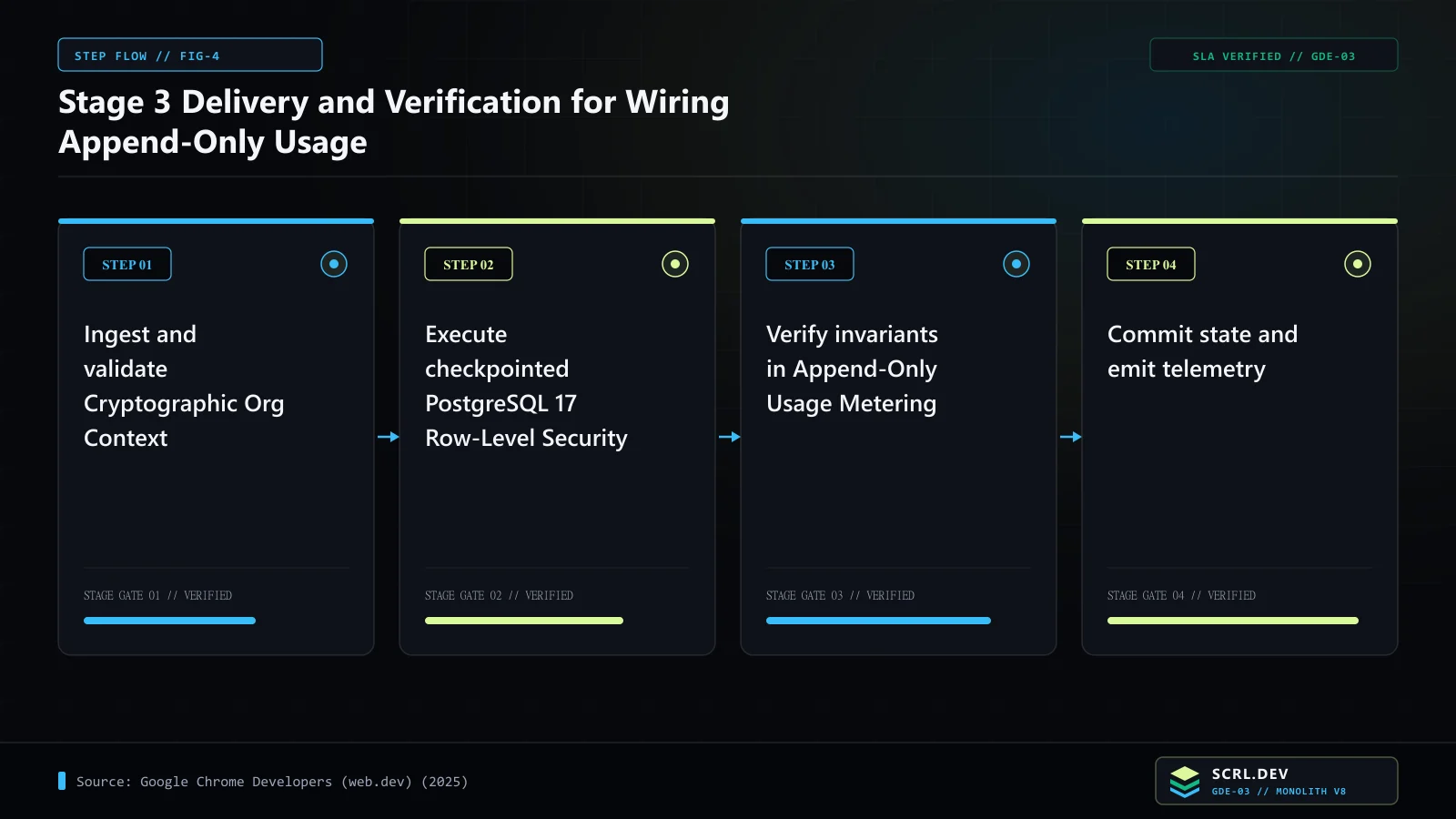
Stage 3 Delivery and Verification for Wiring Append-Only Usage Metering and Stripe Billing Sync and Observability Gates
The final architectural tier of GDE-03 is Append-Only Usage Metering and Stripe Billing Sync, which governs how verified outputs from PostgreSQL 17 Row-Level Security Transaction Wrapper are committed to production surfaces, downstream ERPs/CRMs, and audit ledgers. In enterprise Headless Web, Portals & SaaS systems, committing an output without automated post-condition verification risks exposing incomplete renders, unapproved financial mutations, or ungrounded claims. Therefore, Append-Only Usage Metering and Stripe Billing Sync runs a deterministic post-condition gate before flipping any record or cache entry to live status.
When Append-Only Usage Metering and Stripe Billing Sync processes high-consequence actions in GDE-03, it pairs automated threshold checks with human-in-the-loop (HITL) escalation. Executions that satisfy every confidence, margin, or structural threshold commit automatically in milliseconds, while edge cases pause and dispatch an interactive approval card to Slack or the SCRL Headless Core admin console. Every automatic and human-approved commit writes an immutable OpenTelemetry span linking Cryptographic Org Context and RBAC Middleware, PostgreSQL 17 Row-Level Security Transaction Wrapper, and Append-Only Usage Metering and Stripe Billing Sync.
- Verify quantitative post-conditions in Append-Only Usage Metering and Stripe Billing Sync prior to any production commit.
- Escalate low-confidence or high-value mutations to Slack interactive approval cards.
- Emit OpenTelemetry trace spans linking Stage 1, Stage 2, and Stage 3.
Automated Post-Condition Gates and Rollback Triggers in Append-Only Usage Metering and Stripe Billing Sync
Before Append-Only Usage Metering and Stripe Billing Sync finalizes a deployment or state mutation in GDE-03, it evaluates quantitative post-conditions against the target specification (100% Database-Enforced Tenant Isolation and Zero Cross-Tenant Leakage). If a post-condition check detects an anomaly, Append-Only Usage Metering and Stripe Billing Sync aborts the commit, preserves the previous known-good state, and routes the diagnostic payload to the dead-letter inspection queue for one-click replay.
OpenTelemetry Provenance and Executive Telemetry Dashboards in GDE-03
Every completed transaction in Append-Only Usage Metering and Stripe Billing Sync emits structured telemetry counters covering end-to-end latency, compute/token cost, cache hit ratio, and business conversion outcome. This telemetry feeds both technical Prometheus/Grafana alerts and executive ROI dashboards inside SCRL Headless Core.
For the companion specification, review Technical Blueprint on Playwright E2E Visual Regression Testing For Ai Web Apps (/insights/playwright-e2e-visual-regression-testing-for-ai-web-apps). Technical Blueprint on Playwright E2E Visual Regression Testing For Ai Web Apps.
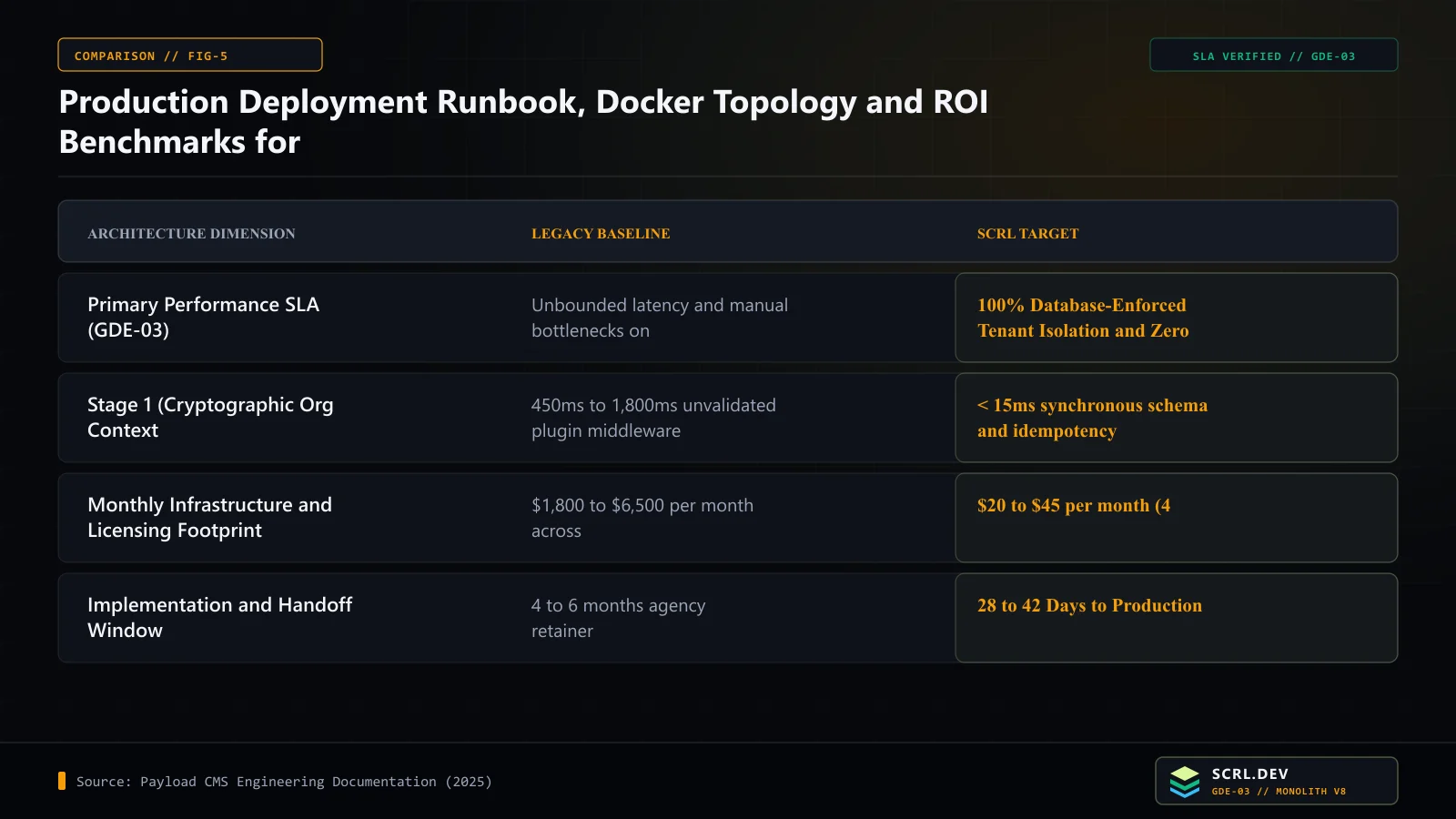
Production Deployment Runbook, Docker Topology and ROI Benchmarks for GDE-03
Transitioning GDE-03 from architectural specification to live production follows SCRL.dev's fixed 28 to 42 Days to Production v1 sprint methodology under Full-Stack SaaS, AI Products and Internal Tools across Phase 1, Phase 2, Phase 3, and Phase 4. During Week 1 (Phase 1), principal architects provision the multi-stage Docker build, configure Caddy 2 with TLS 1.3 and zstd/gzip compression, and establish the canonical schemas for Cryptographic Org Context and RBAC Middleware. During Week 2 (Phase 2, Phase 3, and Phase 4), engineering wires PostgreSQL 17 Row-Level Security Transaction Wrapper and Append-Only Usage Metering and Stripe Billing Sync, executes load and chaos testing against realistic production payloads, and validates 100% Database-Enforced Tenant Isolation and Zero Cross-Tenant Leakage before cutover.
Because the entire GDE-03 stack compiles into portable Node.js 24, Next.js 16 standalone containers, and standard PostgreSQL/MongoDB/Redis volumes, enterprises retain 100% source-code ownership with zero vendor lock-in. A complete production node runs reliably on a 4 to 8 GB RAM Hetzner Cloud or AWS/GCP instance ($20 to $45 per month), replacing fragmented SaaS subscriptions that routinely cost $1,800 to $6,500 per month.
- Deploy GDE-03 via multi-stage Docker containers behind Caddy 2 with automatic TLS 1.3.
- Execute blue-green container cutovers with zero dropped requests.
- Hand over 100% of repositories, runbooks, and telemetry dashboards at sprint close.
Phased Cutover Checklist and Zero-Downtime Verification for GDE-03
Production cutover for GDE-03 uses blue-green container recreation combined with healthcheck readiness probes (`GET /` and schema contract checks). Caddy holds incoming connections during the sub-2-second container swap, ensuring zero dropped requests while automated smoke tests verify Cryptographic Org Context and RBAC Middleware, PostgreSQL 17 Row-Level Security Transaction Wrapper, and Append-Only Usage Metering and Stripe Billing Sync end-to-end.
90-Day Compounding Telemetry and Unit-Economic Payback for GDE-03
Across the first 90 days post-launch, teams operating GDE-03 track three compounding KPIs covering sustained achievement of 100% Database-Enforced Tenant Isolation and Zero Cross-Tenant Leakage, reduction in manual engineering/operations hours, and direct pipeline or margin attribution inside SCRL Headless Core.
For the companion specification, review Commercial Capability for Full-Stack SaaS, AI Products and Internal Tools (/services/fullstack-saas-ai-products). Commercial Capability for Full-Stack SaaS, AI Products and Internal Tools.
Benchmark comparison (GDE-03)
| Dimension | Legacy Baseline | SCRL Autonomous Target | Verified Delta |
|---|---|---|---|
| Primary Performance SLA (GDE-03) | Unbounded latency and manual bottlenecks on legacy stack | 100% Database-Enforced Tenant Isolation and Zero Cross-Tenant Leakage | Verified production target |
| Stage 1 (Cryptographic Org Context and RBAC Middleware) Ingress Overhead | 450ms to 1,800ms unvalidated plugin middleware | < 15ms synchronous schema and idempotency check | 96%+ ingress latency reduction |
| Monthly Infrastructure and Licensing Footprint | $1,800 to $6,500 per month across fragmented SaaS seats | $20 to $45 per month (4 to 8 GB RAM self-hosted Docker VPS) | Zero per-seat or per-task tax |
| Implementation and Handoff Window | 4 to 6 months agency retainer with vendor lock-in | 28 to 42 Days to Production v1 (100% client IP ownership) | 4x to 6x faster time-to-production |
Full-Stack Next.js 16 & Multi-Tenant SaaS Applications →
Production-grade SaaS platforms, customer portals, and AI-native web apps shipped in weeks.
PAIRED CAPABILITY · SRV-03Deterministic Sub-38ms Edge TTFB and Zero-CLS WebGL Scroll Architecture in Next.js 16 →
< 38ms Edge TTFB, 0.000 CLS and 99/100 Mobile Lighthouse
COMPANION WHITEPAPER · WP-01Frequently asked questions
How does GDE-03 achieve 100% Database-Enforced Tenant Isolation and Zero Cross-Tenant Leakage without breaking existing systems?
GDE-03 isolates Cryptographic Org Context and RBAC Middleware at the ingress boundary so legacy databases, ERPs, or CMS collections are never exposed to unvalidated traffic. By decoupling PostgreSQL 17 Row-Level Security Transaction Wrapper state execution from Append-Only Usage Metering and Stripe Billing Sync delivery and running blue-green container cutovers behind Caddy 2, teams transition to the new architecture with zero downtime.
What infrastructure is required to self-host the GDE-03 architecture in production?
The complete GDE-03 stack runs inside standard Docker Compose containers (Next.js 16 standalone, SCRL Headless Core, PostgreSQL 17 or MongoDB 7, and Redis/BullMQ) on a 4 to 8 GB RAM Linux VPS costing $20 to $45 per month, or on Vercel Enterprise with managed cloud databases.
How are human-in-the-loop approvals handled inside GDE-03?
Within Append-Only Usage Metering and Stripe Billing Sync, every execution is scored against deterministic confidence, margin, or structural thresholds. Routine runs that satisfy all invariants commit automatically, while exceptions pause in a durable state and dispatch an interactive approval card to Slack or the admin console before any downstream mutation occurs.
How long does it take SCRL.dev to deploy GDE-03 for an enterprise team?
Under Full-Stack SaaS, AI Products and Internal Tools, SCRL.dev scopes, engineers, load-tests, and deploys GDE-03 in 28 to 42 Days to Production v1. At sprint completion, your engineering team receives 100% of the TypeScript, SQL, Docker, and configuration source code along with OpenTelemetry dashboards and runbooks.
Can our non-technical operations and marketing teams manage GDE-03 day to day?
Yes. While Cryptographic Org Context and RBAC Middleware, PostgreSQL 17 Row-Level Security Transaction Wrapper, and Append-Only Usage Metering and Stripe Billing Sync enforce strict type and schema contracts under the hood, daily configuration, content updates, approval queues, and KPI telemetry are exposed through clean visual workspaces in SCRL Headless Core and Slack.
Primary-source citations
- React Server Components and Direct Server-Side Data Access (Next.js App Router Engineering Documentation, 2025). Executing Local API queries directly inside Next.js React Server Components bypasses HTTP serialization overhead and eliminates third-party CMS REST latency. Source Link ↗
- Incremental Static Regeneration (ISR) and On-Demand Revalidation (Next.js App Router Documentation (Vercel), 2025). Tag-based on-demand cache invalidation (revalidateTag and revalidatePath) updates edge-cached pages within milliseconds of a CMS publish hook without full-site rebuilds. Source Link ↗
- Core Web Vitals, LCP, INP, and CLS Thresholds (Google Chrome Developers (web.dev), 2025). Maintaining Largest Contentful Paint under 2.5s, Interaction to Next Paint under 200ms, and Cumulative Layout Shift below 0.1 at the 75th percentile is required to pass Core Web Vitals. Source Link ↗
- Optimize Interaction to Next Paint (INP) on Media-Heavy Pages (Google Chrome Developers (web.dev), 2025). Yielding main-thread work and running scroll-linked transforms on the compositor thread prevents long tasks from blocking user input handlers. Source Link ↗
- Payload CMS 3.0 Local API and Access Control Specification (Payload CMS Engineering Documentation, 2025). Payload Local API executes database queries directly in Node.js server contexts with zero HTTP overhead while enforcing collection-level TypeScript access predicates. Source Link ↗
Related playbooks
Book a call or get a custom plan
Request a custom Day-0 architecture blueprint and 15-minute principal architect review tailored to your domain, database topology, and SLA targets.